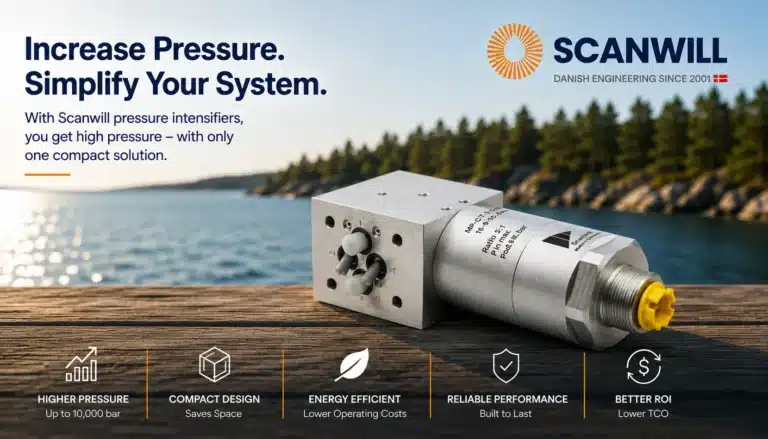
More pressure without more machine

It often starts with one requirement. A clamp needs more force. A test station needs a short high-pressure cycle. A tool has to do a job the existing circuit cannot quite deliver.

The obvious response is to increase the capability of the hydraulic system around it. A larger pump. A higher system pressure. More high-pressure infrastructure.

But before the machine grows, there is a simpler question worth asking: where is the higher pressure actually needed?

Find the pressure bottleneck first

If high pressure is only needed at one function, it can make more sense to create it close to the point of use. A pressure intensifier uses the existing hydraulic supply and increases pressure locally when required.

That changes the design conversation. Instead of upgrading everything around the requirement, the engineer can focus on the one place where extra force is needed.

The expensive default

When one local requirement drives a system-wide redesign, the cost is not only hydraulic hardware. It can also mean more space, more piping, more interfaces and more decisions elsewhere in the machine.

What you do not add can be just as important

Compact hydraulic design is not about making parts small for its own sake. It is about avoiding complexity that does not contribute to the job the machine has to perform.

✓ Keep the main hydraulic architecture focused on the pressure most functions actually require.

✓ Create higher pressure only at the function that needs it.

✓ Avoid using valuable machine space for high-pressure capacity that is only used intermittently.

✓ Give engineers more freedom when retrofitting or adding a new function to an existing machine.

Good engineering is often about what you do not have to redesign

The interesting outcome is not simply higher pressure. It is the ability to add the required force while keeping the rest of the machine closer to the architecture you already wanted.

More pressure can be a local problem. The solution can be local too.

Do you need help?

Use the search function below.